Admin
Admin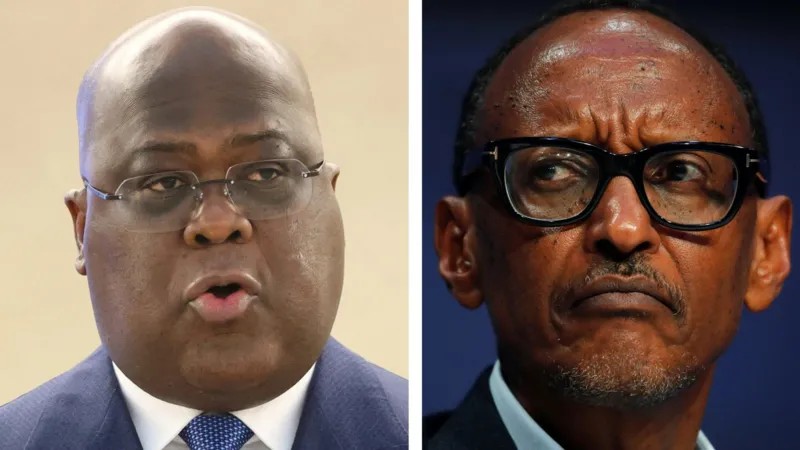
Report by Emmanuel Garjiek
The presidents of the Democratic Republic of Congo (DR Congo) and Rwanda are expected to sign a peace agreement in Washington at a summit hosted by US President Donald Trump, in a bid to end decades of conflict in eastern DR Congo.
The ceremony comes amid renewed fighting between DR Congo’s army and the M23 rebel group, which Kinshasa accuses Rwanda of backing. The Congolese military has accused its rivals of attempting to “sabotage” the peace process, while the rebels claim government forces violated a ceasefire by launching new operations.
Earlier this year, the M23 seized large parts of eastern DR Congo in an offensive that left thousands dead and displaced many more. Relations between DR Congo’s President Félix Tshisekedi and Rwandan President Paul Kagame have deteriorated sharply, with both leaders trading accusations over the root causes of the conflict.
The peace accord—first initialled by the countries’ foreign ministers in June—is now set for endorsement by the two presidents, with leaders from Burundi, Qatar and other African and Arab states expected to attend.
The M23 will not participate in the event, as it is currently involved in a parallel Qatar-led peace process with the Congolese government.
Washington has played a central role in bringing the two neighbours to the negotiating table, viewing the stabilization of the region as essential for unlocking major US investment opportunities in DR Congo’s mineral-rich east. The country is estimated to hold $25 trillion worth of key minerals such as cobalt, copper, lithium and tantalum, crucial for global technology and energy industries.
Trump has previously said the peace efforts would secure significant mineral rights for the United States.
However, analysts have voiced doubts about the deal’s durability. Bram Verelst of the Institute for Security Studies told the BBC that with no functioning ceasefire and M23 rebels consolidating their positions, the signing ceremony “is unlikely to alter the situation on the ground”.
M23 rebels currently control strategic cities including Goma and Bukavu. Fresh clashes were reported this week in South Kivu, where the DR Congo army accused the rebels of launching new attacks near Uvira. The M23 countered that Congolese forces, supported by Burundian troops, had undertaken air and ground assaults—an allegation Burundi has not addressed.
Rwanda maintains that its presence in eastern DR Congo is necessary to counter the FDLR, a militia with members linked to the 1994 genocide. Kagame insists that the group must be disarmed, while Kinshasa demands the withdrawal of Rwandan troops—both conditions included in the new agreement.
Past peace deals since the 1990s have collapsed over disagreements related to the FDLR’s disarmament.
Negotiators from Qatar and the US are coordinating their mediation strategies, with each maintaining closer ties to different sides of the conflict. While DR Congo has signaled willingness to sign the broader economic and political cooperation framework, President Tshisekedi has insisted that no progress will be made until Rwandan forces withdraw from Congolese territory.


 Arop
Arop