Admin
Admin
Report by: Al-Naeim Mubarak Kuol
Al-Wadi Newspaper – 30 January 2026
Despite the ongoing war in South Sudan between the two parties to the conflict—the government and the Sudan People’s Liberation Movement in Opposition—the general public continues to await the emergence of a third national actor, represented by the active political parties in the country, to play their natural role in calling for dialogue and prioritizing the interests of citizens and the nation over narrow self-interests. However, this role has remained absent to date, as no political initiative has been recorded—neither through a public forum nor through an official statement clarifying these parties’ positions on the unfolding events or informing public opinion and South Sudanese citizens of the realities and consequences of the ongoing war.
In a street survey on the silence of political parties, several citizens expressed the view that these parties care only about their own interests and gains, describing them as “tok parties,” a term implying parties that seek privileges and benefits only. They ask: if parties are keen on their own interests, should they not at least issue a statement warning the two sides to the conflict that the continuation of the war could sweep everyone away, that the “soup” could spill from the table of power, and that no one would benefit from the continuation of the conflict?
Many agree that the real problem in South Sudan lies in the fact that political disputes are often managed through settling scores using armed violence. Citizens believe that when fighting erupts, political parties rush to hide in “fortified rooms” until the war ends, without contributing to peacebuilding. Instead, they argue, these parties should clearly condemn the war, demand its immediate cessation, expose those responsible, and call for holding them accountable in order to stop the bleeding of innocent citizens’ blood.
One citizen said that political parties are unable to expose those responsible for wars and demand their prosecution because doing so could mean their political end in South Sudan. He added that the demand for freedom of expression and opinion remains fundamental, but these freedoms cannot be realized without people who actively demand them, citing the proverb: “A right is never lost as long as there is someone who demands it.”
Others believe that political parties signatory to the Revitalized Peace Agreement and others originally emerged in an opposition context, consistently calling for political freedoms, security arrangements, and the drafting of a permanent constitution. Yet today’s reality indicates that most leaders of these parties are either in prison, in exile, in the bush, or have passed away, while the government has gone as far as registering political parties in U.S. dollars—as if South Sudan were a state of the United States—an action observers consider an attempt to weaken these parties and marginalize them from the political scene.
Nevertheless, citizens stress that parties that call themselves “political parties” are required to shoulder their national responsibility and appear before public opinion at this critical moment to clarify their position and role in easing tensions and demanding the restoration of peace. Their silence, they argue, is implicitly interpreted as approval of the continued suffering of the South Sudanese people.
In this context, one youth activist on social media said that some parties are indeed working, both inside and outside the country, to reduce tensions and support peace efforts. However, the real problem—according to him—is that everyone knows which party does not want peace or the implementation of agreements, for reasons well understood.
Activists argue that merely calling on political parties is no longer sufficient, given that they are interest-based actors and partners in the conflict. They emphasize that the most important role at this stage should be played by civil society organizations, religious leaders, and traditional administrations, through serious efforts to mediate and bring the parties together at the table of national dialogue.
One youth noted that the political parties they once knew have “merged into the big dish,” a metaphor referring to power and its temptations, asking how one can talk about political parties in a geographical space that has yet to agree on a unifying social contract that defines the national interest.
Another young man affirmed that the people of South Sudan gave everything they had to expel the jalaba, but after independence they did not sit down to establish a social contract that answers the question: how do we govern South Sudan? Many believe that the country is still in a pre-state phase, and that the time has come to demand peace, hold a comprehensive national dialogue, agree on a system of governance, and draft a permanent constitution.
Some speakers went as far as describing political parties as “cardboard parties,” arguing that the time has come for them to disintegrate and be consigned to the “dustbin of history” if they fail to perform their national role.
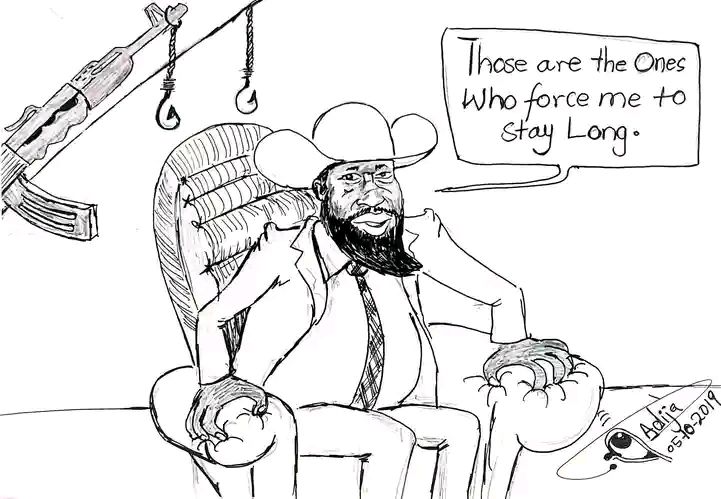
Observers of the political scene believe that the current system is characterized by authoritarianism and chaos, does not tolerate any political practice that criticizes it or exposes its political and economic failures, and seeks to restrict freedom of expression and opinion. For this reason, most parties have chosen silence and absence rather than putting forward any serious political will for reform. Yet authoritarianism, if left unchallenged, will continue indefinitely.
Observers conclude that there is little value in the existence of political parties in the absence of political culture and national responsibility, as this absence neither helps to stop the war nor to establish security and peace in the country.


 Arop
Arop